
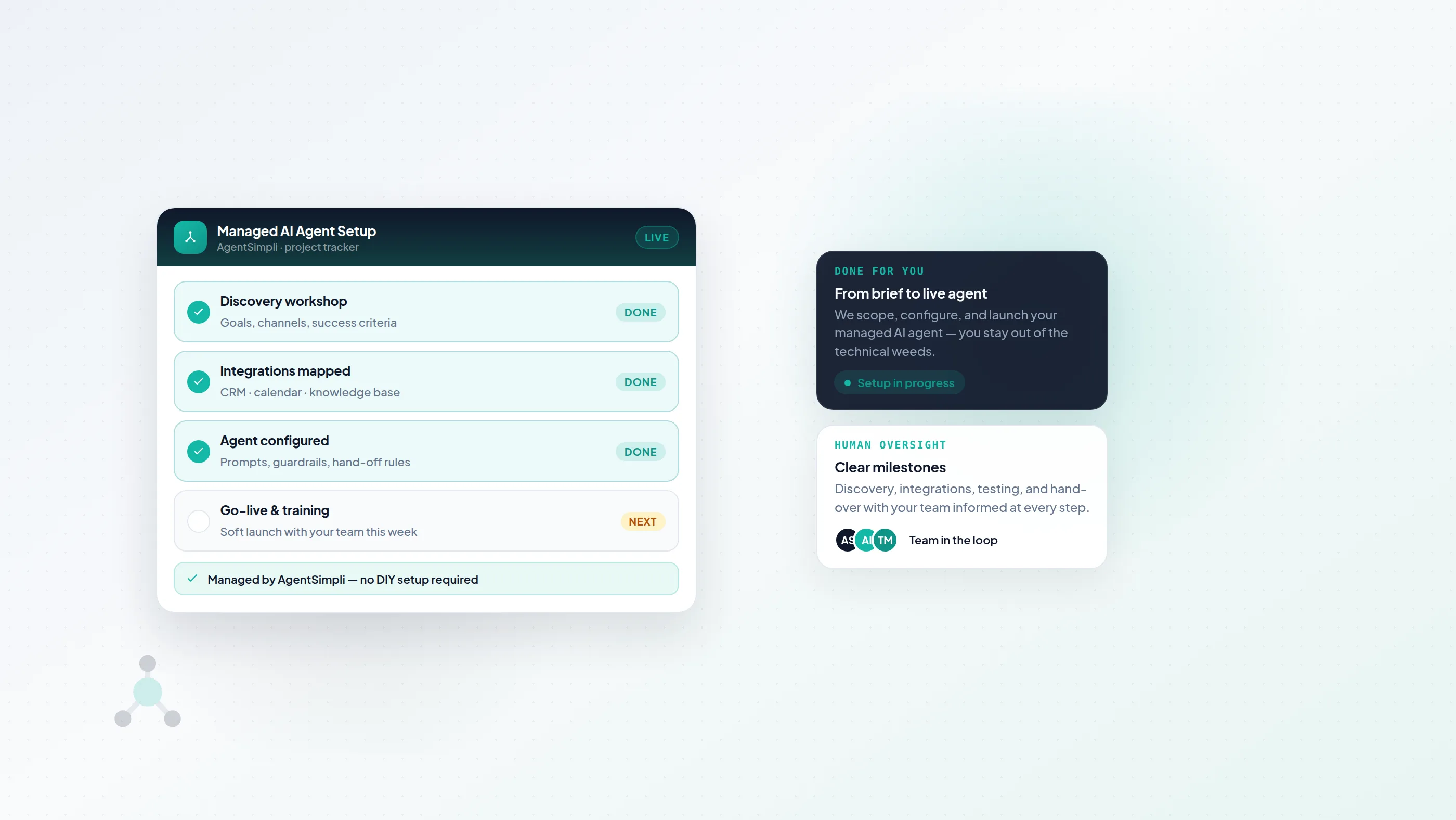
Managed AI Agent Setup
We design, configure, and launch a managed AI agent for your business — discovery through go-live, without the DIY complexity.
Learn more →Managed AI Agents. Simplified.
We help businesses use AI agents to reduce repetitive work, respond faster, and improve everyday operations. AgentSimpli handles the setup, management, and ongoing improvement so you do not need to build or manage the technology yourself.
Setup, onboarding, and ongoing management handled by the AgentSimpli team.
You may know that AI could help your business, but turning that idea into a working, reliable agent is not always simple. You need the right use case, clear instructions, safe boundaries, practical workflows, and ongoing improvement. That is where AgentSimpli helps.
AgentSimpli is a Managed AI Agent Agency. We identify useful workflows, build the agent, and manage it on your behalf — with human oversight at every stage.
Clear scope, plain language, and a managed process that does not require technical expertise.
Every agent is designed around a real business task — not AI hype or novelty features.
Your setup is reviewed and improved by our team so automation stays useful and accountable.
AI agents can support many everyday business tasks, from handling enquiries to preparing internal summaries. We help you choose the right starting point and manage the setup from there.
We design, configure, and launch a managed AI agent for your business — discovery through go-live, without the DIY complexity.
Learn more →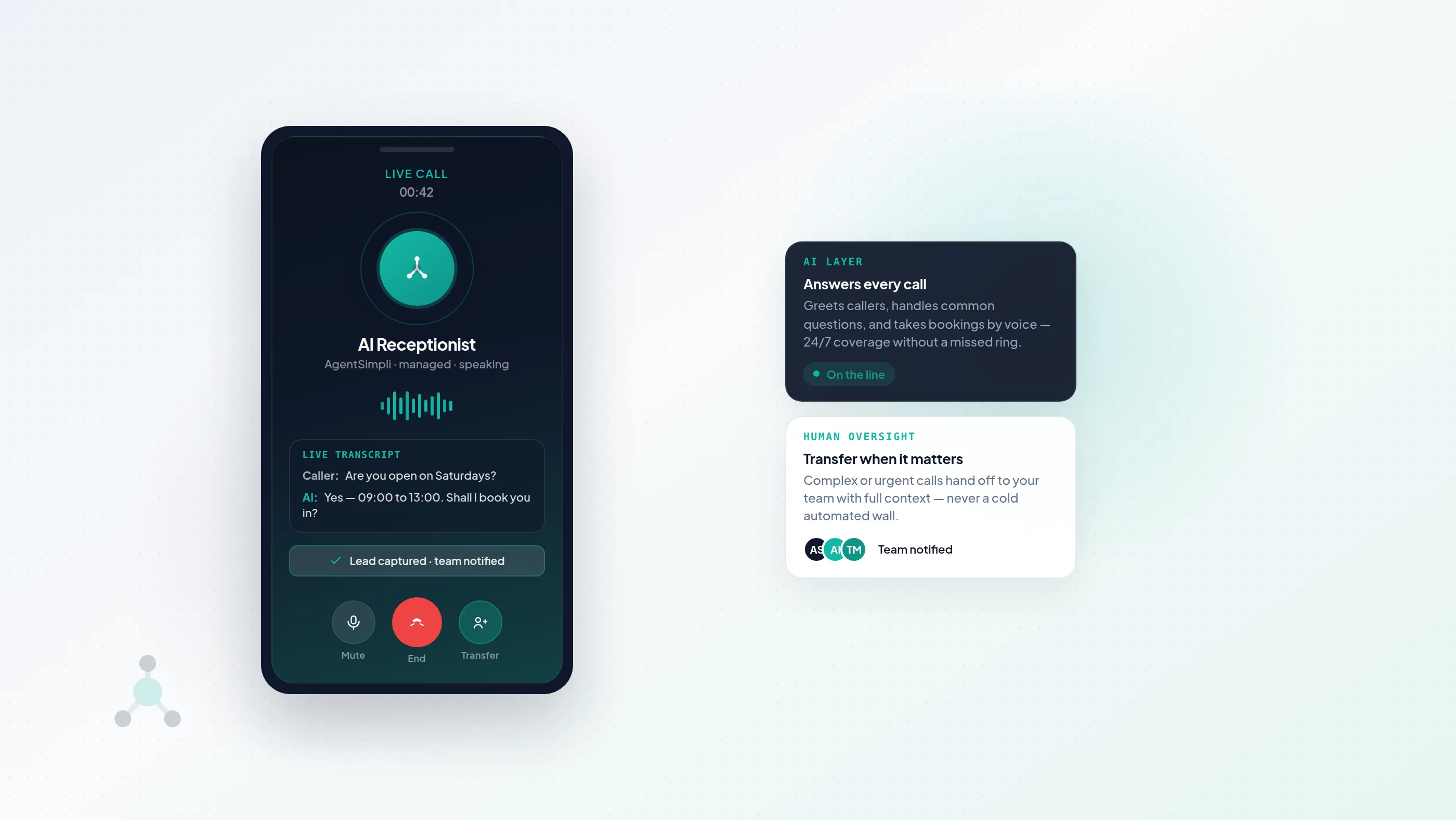
Handle client greetings, routine enquiries, and appointment management on WhatsApp 24/7 — so your team focuses on high-value work.
Learn more →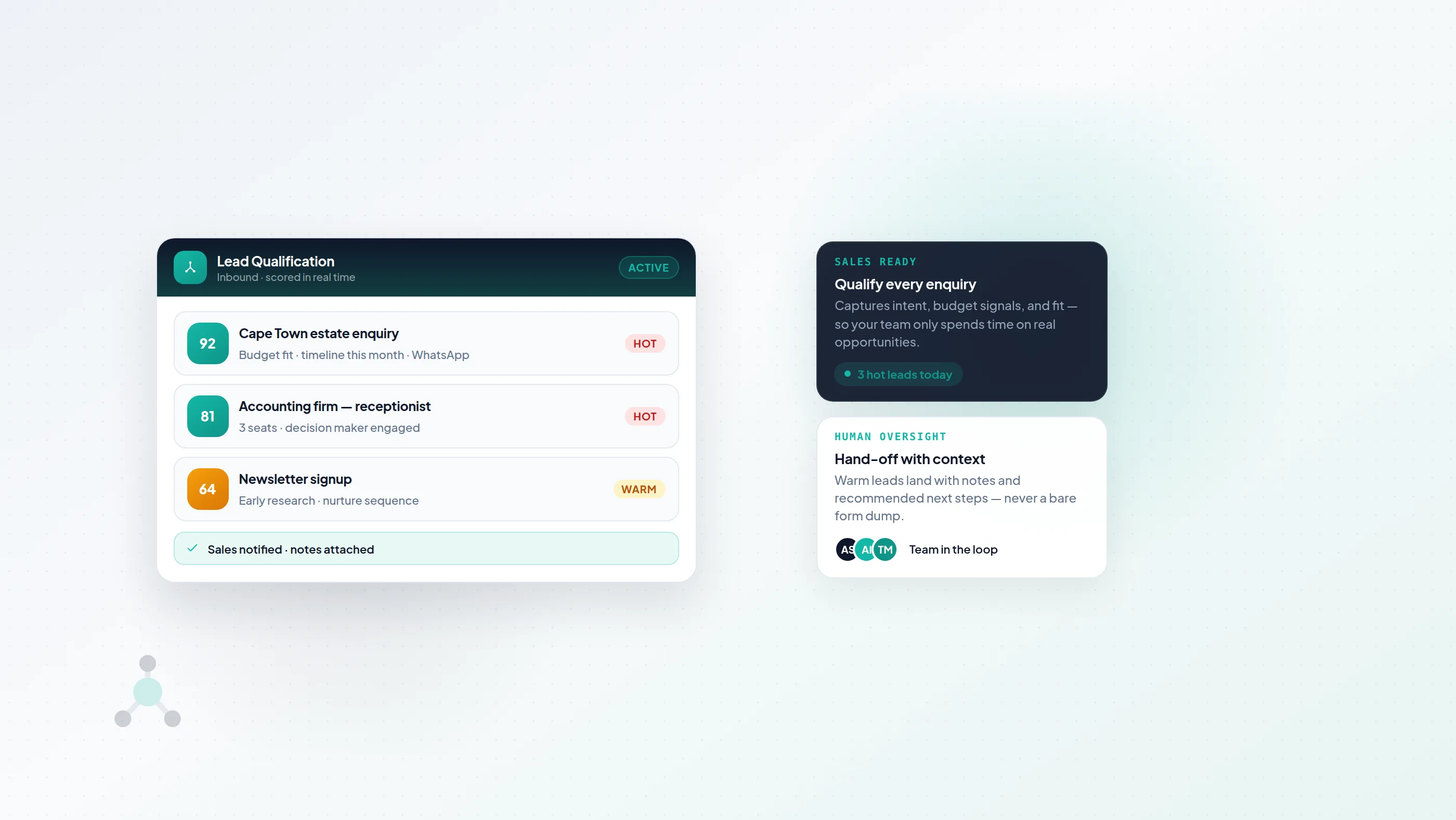
Score and route inbound enquiries so your sales team only spends time on real opportunities — with full context on every hand-off.
Learn more →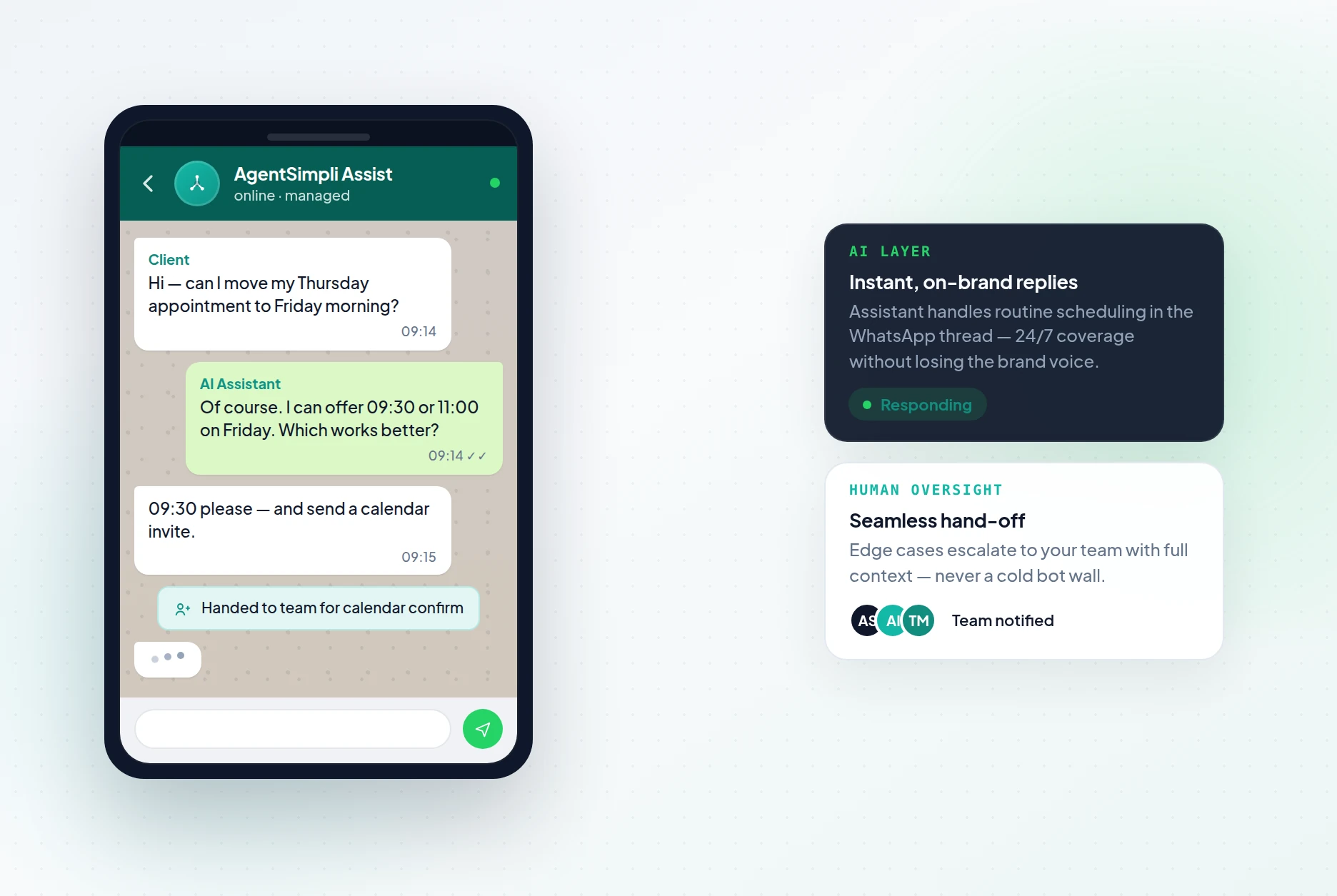
Handle routine client messages, reminders, and document requests on WhatsApp 24/7 — so your team focuses on high-value work.
Learn more →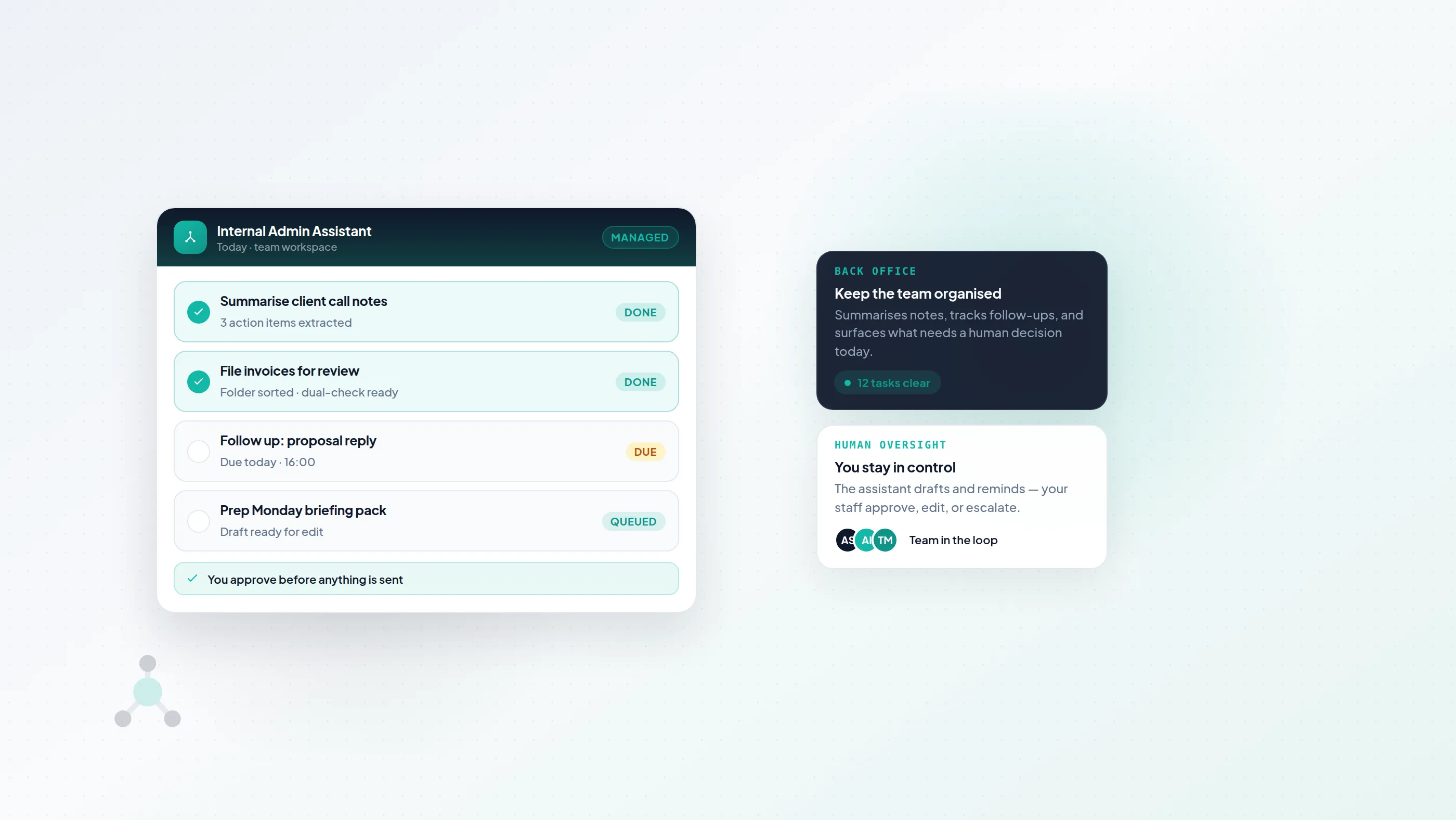
Keep the team organised with summaries, follow-ups, and admin drafts — always with a human approving what goes out.
Learn more →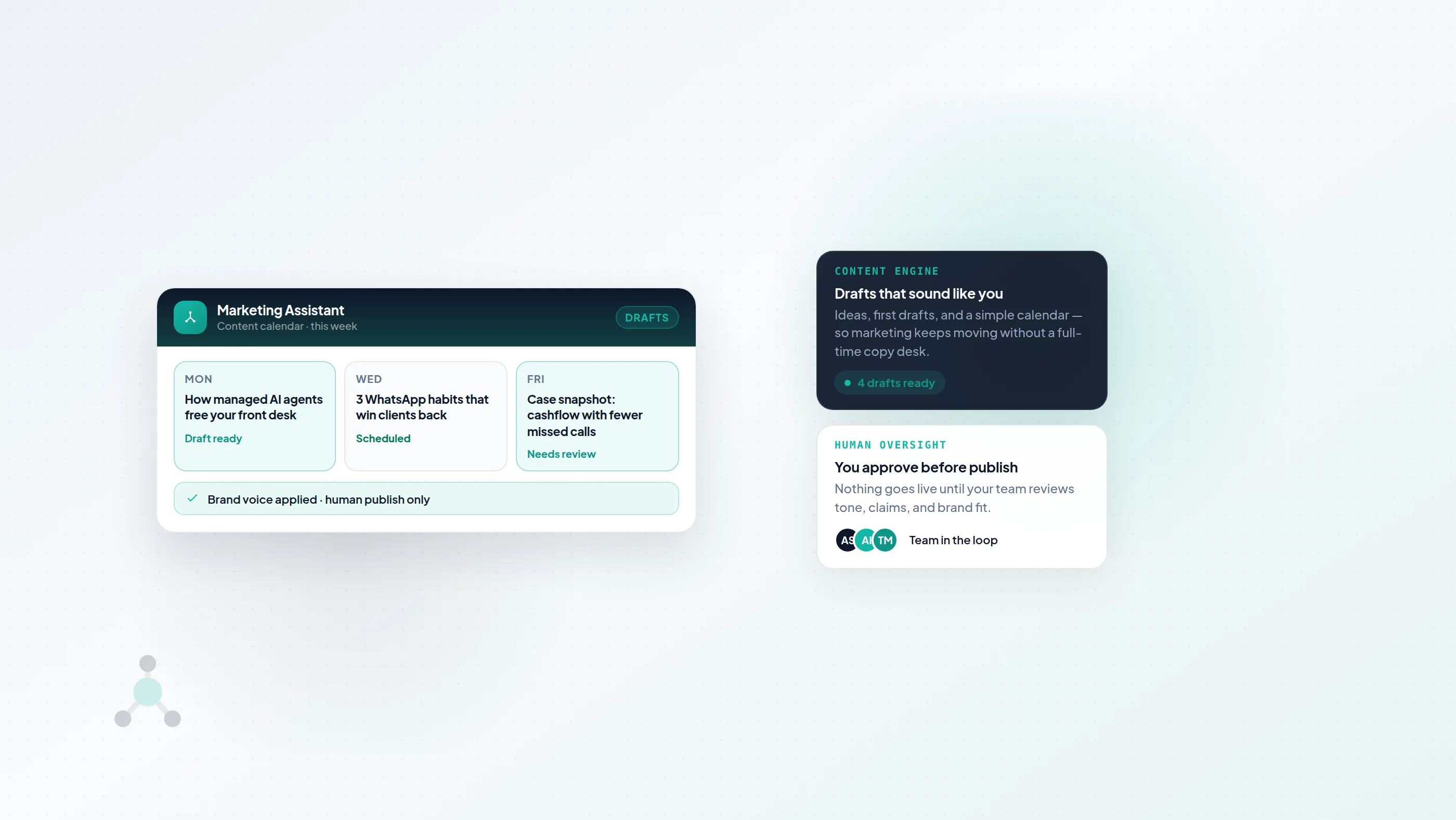
Draft on-brand content and keep a simple marketing calendar moving — you approve before anything is published.
Learn more →A clear, managed process from discovery through to ongoing improvement.
We learn about your business, current workflows, and repetitive tasks.
We define the role, boundaries, instructions, and success criteria for your AI agent.
We build and configure the agent using our managed AI agent workflow.
We review, improve, and support the agent over time so it stays useful.
Start with one practical workflow and expand when it is working well.
Start with a managed AI agent package, or explore custom software development and systems integration — quoted per project when fixed pricing does not fit.
Your entry point into managed AI agents — we scope, build, and manage your first agent with human oversight, without you needing to handle prompts, integrations, or day-to-day maintenance.
ZAR 4,999 setup
+ ZAR 1,799 / month
Bespoke software, APIs, and systems integration when a standard managed agent package is not enough — scoped and quoted per project after consultation.
Quoted per project
Scoped after consultation
We make AI agents useful, manageable, and accessible — without asking you to become an AI expert.
Your AI agent setup is reviewed and managed by humans.
We help define clear boundaries for what each agent should and should not do.
We focus on practical workflows, not uncontrolled automation.
We help you start with a simple use case before expanding.
We manage the technical setup so your team can focus on the business process.
AI agents support your team — they do not remove accountability.
A practical checklist to decide whether you are ready to pilot AItools and AI agents— where the gaps are, and what to fix first. Builtfor SMB use, not enterprise bureaucracy.
Free download. No obligation. Human-reviewed recommendations.
Free tool
Enter your domain for a plain-language review PDF — the same format our SEO agent uses. Name and email required; usually ready within a few minutes.
Free for public websites. Limited per domain so the service stays fair.
Straight answers to common questions about managed AI agents.
For the same reason you wouldn't hire one person to be your receptionist, your bookkeeper, and your IT administrator all at once — and then give that person the keys to everything in the building.
When we set up AI assistants for a business, we deliberately build a separate agent for each job. One might answer client questions on WhatsApp. Another might handle invoice reminders. Another might help you internally with reports and admin. Each one is built, tested, and locked down for its specific role.
Here's why that matters to you:
1. Safety: each agent can only touch what it needs
Our client-facing agents work on a strict "need to know" basis. The assistant that chats to your clients on WhatsApp can see the information required to answer their questions — and nothing else. It has no access to your accounting system, your files, or your server. Even in the worst case, where someone tries to trick or misuse it, there's very little it could do, because it was never given the keys in the first place.
A single do-everything agent would need access to everything, all the time. That means one weak point could expose your whole business. Separate agents mean small, contained risks instead of one big one.
2. Privacy: your client data stays in its lane
Because each agent only sees the information relevant to its job, it's much easier to protect personal information and comply with privacy laws like POPIA. The agent answering a client about their own matter simply cannot reach into another client's information — the walls are built in from day one, not added later.
3. Quality: specialists outperform generalists
An agent with one clear job, clear instructions, and a focused set of knowledge gives faster, more accurate, and more consistent answers. An agent asked to juggle twenty unrelated tasks gets confused more easily — just like people do. Narrow focus is what makes these assistants reliable enough to put in front of your clients.
4. Reliability: one problem never takes everything down
If one agent needs an update, or something goes wrong with it, the others carry on working. We can improve your invoice-reminder agent on a Tuesday afternoon without your client WhatsApp line missing a single message. With one giant agent, every change risks breaking everything at once.
5. Growth: start small, add as you go
Separate agents mean you don't have to buy a "whole system" upfront. Most of our clients start with one assistant solving their most painful problem. When you're ready for the next one, we add it alongside — without rebuilding or disturbing what already works.
In short: we build your AI assistants the way you'd build a good team — the right specialist for each job, each trusted with exactly as much as their job requires, and no more. It's safer, it works better, and it grows with you.
Short answer: keeping your data safe is the core of how we build, not an afterthought.
Here's what that means in practice, in plain terms:
Your assistant runs on its own server — not shared with other businesses. Each client gets their own private setup. Your information is never mixed into a shared pool with other companies' data.
Each agent only sees what its job requires. As explained in the question above, your client-facing assistant works on a "need to know" basis. It answers from a carefully prepared set of information that we agree with you upfront. It cannot go digging through your systems, and it cannot reveal what it was never given.
One client can never see another client's information. When your assistant chats to a client on WhatsApp, it responds based on who that person is. Mrs Botha can ask about Mrs Botha's matters — the assistant simply has no way to hand her anyone else's.
Personal details are protected before they reach the AI. Where possible, identifying details like phone numbers are masked before any message is processed by the underlying AI model. And because we manage the whole setup, we can also run the most sensitive steps — like transcribing recorded meetings — entirely on your own server, so that material never leaves it.
Everything is logged. We keep records of what your assistant does, so there's always an answer to "what did it say, and to whom?" Sensitive details like passwords and keys are automatically hidden from these logs.
And the honest part: no system on earth — human or AI — is 100% risk-free. What responsible design does is make sure that even if something goes wrong, the damage is small and contained. That's exactly why we build separate, limited agents instead of one all-powerful one. We treat your data the way we treat our own — because we run these same assistants in our own practice, on our own clients' information, every day.
It says so — and hands over to a human. That's a feature, not a failure.
Every assistant we build is given two things: a set of information it's allowed to answer from, and clear instructions for what to do when a question falls outside it. When that happens, the assistant:
1. Tells the client honestly. Something like: "That's a good question — I'll ask the team and someone will come back to you." No guessing, no made-up answers. An assistant that bluffs is worse than no assistant at all, so ours are specifically instructed not to.
2. Notifies you or your team. The unanswered question is passed on immediately, so a person can pick it up. Your client gets a fast acknowledgement at 9pm and a proper answer from a human the next morning — which is still a far better experience than a message that sits unread all weekend.
3. Logs the question. This is the quietly valuable part. Every "I don't know" is recorded, and we review them with you. If ten clients ask the same thing this month, we add it to the assistant's knowledge — so your assistant genuinely gets better at your business over time, based on what your clients actually ask.
Two related situations worth mentioning:
Sensitive or high-stakes questions are handed over on purpose. Some things shouldn't be answered by an assistant even if it technically could — a complaint, a fee dispute, complex advice. We agree these categories with you upfront, and the assistant routes them straight to a person.
It won't pretend to be human. Your assistant introduces itself as a digital assistant. Clients respond well to this — what they care about is getting a fast, accurate answer, not whether it was typed by a person. And it builds trust: nobody feels tricked.
No. We build around what you already have — that's the whole point of how we work.
Your clients don't change anything. The assistant lives on WhatsApp, which your clients already use every day. There's no app to download, no portal to log into, no "please register on our new system" email. They message you the way they always have; the assistant simply answers.
You don't change your software. Whether you run Sage, Pastel, Xero or something else, your systems stay exactly as they are. In the simplest setup, the assistant works from information we prepare together — no connection to your software at all. If you later want the assistant to look things up directly (for example, checking an invoice status in your accounting system), we build a small, read-only bridge to it. Your software doesn't know or care that anything changed; the assistant just politely asks it questions.
You start small. Most clients begin with one assistant doing one job — typically answering common client questions on WhatsApp. That first step usually takes a few weeks from our first conversation to going live, and most of that is us learning your business, not you doing work. Your part is mainly a few conversations and reviewing what the assistant will say.
And if you stop? Nothing breaks. Because we built alongside your systems rather than inside them, switching the assistant off leaves your business exactly as it was before. You're never locked in, and your data remains yours.
The short version: our job is to fit into your business. If a provider tells you to change your systems, your software, and your way of working before their AI can help you — that's their limitation, not yours.
Book a consultation and complete our intake form so we can prepare for your requirements review. See our process for what happens next.